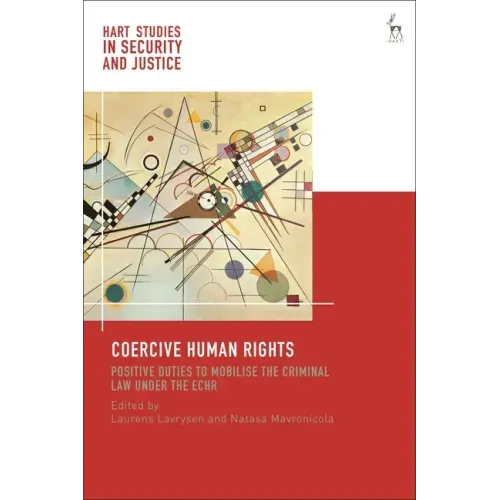
Coercive Human Rights: Positive Duties to Mobilise the Criminal Law under the ECHR - Paperback
Coercive Human Rights: Positive Duties to Mobilise the Criminal Law under the ECHR - Paperback
Couldn't load pickup availability
Share
by Laurens Lavrysen (Editor), Natasa Mavronicola (Editor)
Traditionally, human rights have protected those facing the sharp edge of the criminal justice system. But over time human rights law has become increasingly infused with duties to mobilise criminal law towards protection and redress for violation of rights. These developments give rise to a whole host of questions concerning the precise parameters of coercive human rights, the rationale(s) that underpin them, and their effects and implications for victims, perpetrators, domestic legal systems, and for the theory and practice of human rights and criminal justice. This collection addresses these questions with a focus on the rich jurisprudence of the European Court of Human Rights (ECtHR).
The collection explores four interlocking themes surrounding the issue of coercive human rights:
First, the key threads in the doctrine of the ECtHR on duties to mobilise the criminal law as a means of delivering human rights protection.
Secondly, the factors that contribute to a readiness to demand coercive measures, including discrimination and vulnerability, and other key justificatory reasoning shaping the development of coercive human rights.
Thirdly, the most pressing challenges for the ECtHR's coercive duties doctrine, including:
- how it relates to theories and rationales of criminalisation and criminal punishment;
- its implications for the fundamental tenets of human rights law itself;
- its relationship to transitional justice objectives; and
- how (far) it coheres with the imperative of effective protection for persons in precarious or vulnerable situations.
Fourthly, the (prospective) evolution of the coercive human rights doctrine and its application within national jurisdictions
Author Biography
Laurens Lavrysen is a Postdoctoral Researcher (funded by the FWO - Research Foundation Flanders), connected to the Human Rights Centre of Ghent University.
Natasa Mavronicola is Reader in Law at Birmingham Law School, University of Birmingham.