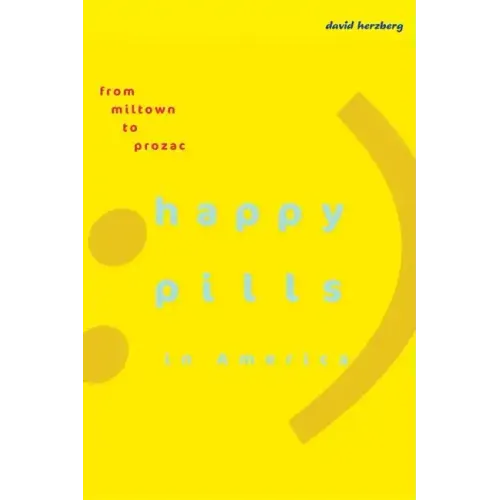
Happy Pills in America: From Miltown to Prozac - Paperback
Happy Pills in America: From Miltown to Prozac - Paperback
Couldn't load pickup availability
Share
by David Herzberg (Author)
Valium. Paxil. Prozac. Prescribed by the millions each year, these medications have been hailed as wonder drugs and vilified as numbing and addictive crutches. Where did this "blockbuster drug" phenomenon come from? What factors led to the mass acceptance of tranquilizers and antidepressants? And how has their widespread use affected American culture?
David Herzberg addresses these questions by tracing the rise of psychiatric medicines, from Miltown in the 1950s to Valium in the 1970s to Prozac in the 1990s. The result is more than a story of doctors and patients. From bare-knuckled marketing campaigns to political activism by feminists and antidrug warriors, the fate of psychopharmacology has been intimately wrapped up in the broader currents of modern American history. Beginning with the emergence of a medical marketplace for psychoactive drugs in the postwar consumer culture, Herzberg traces how "happy pills" became embroiled in Cold War gender battles and the explosive politics of the "war against drugs"--and how feminists brought the two issues together in a dramatic campaign against Valium addiction in the 1970s. A final look at antidepressants shows that even the Prozac phenomenon owed as much to commerce and culture as to scientific wizardry.
With a barrage of "ask your doctor about" advertisements competing for attention with shocking news of drug company malfeasance, Happy Pills is an invaluable look at how the commercialization of medicine has transformed American culture since the end of World War II.
Front Jacket
David Herzberg follows the rise of psychiatric medicines, from Miltown in the 1950s to Valium in the 1970s to Prozac in the 1990s. After a market for psychoactive drugs emerged in the postwar consumer culture, "happy pills" became embroiled in Cold War gender battles and the explosive politics of the "war against drugs". In a dramatic campaign against Valium addiction, feminists brought the two issues together in the 1970s. The Prozac phenomenon, too, owed as much to commerce and culture as to scientific achievement. Happy Pills is an invaluable look at how the commercialization of medicine has transformed American culture since the end of World War II.
Excellent . . . stresses the dynamics of sex roles and social class that underlie the culture of psychotropic drug use.--New England Journal of Medicine
Draws attention to the important issue of happiness as an increasingly medicalized commodity in that context.--Bulletin of the History of Medicine
By placing human action at the heart of this culturally rich history, Herzberg has written a masterful account of the travels of 'happy pills' from Madison Avenue to your medicine cabinet.--Journal of the History of the Behavioral Sciences
A brilliant book, rich and mind-bending . . . Unlike most others on the subject, Happy Pills seeks not to condemn or celebrate but to understand.--Business History Review
Herzberg eloquently guides us through the world of happy pills in post-World War II America . . . Engaging, insightful, and well researched.--Journal of American History
David Herzberg is an assistant professor of history at the State University of New York at Buffalo.
--Lizabeth Cohen, author of A Consumers' Republic: The Politics of Mass Consumption in Postwar America "Sociology of Health and Illness"Back Jacket
David Herzberg follows the rise of psychiatric medicines, from Miltown in the 1950s to Valium in the 1970s to Prozac in the 1990s. After a market for psychoactive drugs emerged in the postwar consumer culture, "happy pills" became embroiled in Cold War gender battles and the explosive politics of the "war against drugs". In a dramatic campaign against Valium addiction, feminists brought the two issues together in the 1970s. The Prozac phenomenon, too, owed as much to commerce and culture as to scientific achievement. Happy Pills is an invaluable look at how the commercialization of medicine has transformed American culture since the end of World War II.
"Excellent . . . stresses the dynamics of sex roles and social class that underlie the culture of psychotropic drug use."--New England Journal of Medicine
"Draws attention to the important issue of happiness as an increasingly medicalized commodity in that context."--Bulletin of the History of Medicine
"By placing human action at the heart of this culturally rich history, Herzberg has written a masterful account of the travels of 'happy pills' from Madison Avenue to your medicine cabinet."--Journal of the History of the Behavioral Sciences
"A brilliant book, rich and mind-bending . . . Unlike most others on the subject, Happy Pills seeks not to condemn or celebrate but to understand."--Business History Review
"Herzberg eloquently guides us through the world of happy pills in post-World War II America . . . Engaging, insightful, and well researched."--Journal of American History
David Herzberg is an assistant professor of history at the State University of New York at Buffalo.
Author Biography
David Herzberg is an assistant professor of history at the State University of New York at Buffalo.