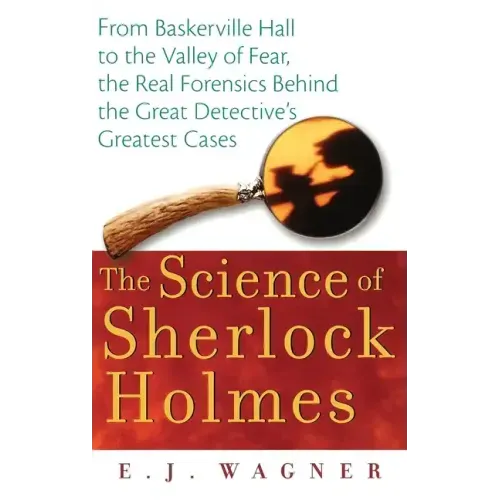
The Science of Sherlock Holmes: From Baskerville Hall to the Valley of Fear, the Real Forensics Behind the Great Detective's Greatest Cases - Hardcover
The Science of Sherlock Holmes: From Baskerville Hall to the Valley of Fear, the Real Forensics Behind the Great Detective's Greatest Cases - Hardcover
Couldn't load pickup availability
Share
by E. J. Wagner (Author)
Praise for The Science of Sherlock Holmes
""Holmes is, first, a great detective, but he has also proven to be a great scientist, whether dabbling with poisons, tobacco ash, or tire marks. Wagner explores this fascinating aspect of his career by showing how his investigations were grounded in the cutting-edge science of his day, especially the emerging field of forensics.... Utterly compelling.""
--Otto Penzler, member of the Baker Street Irregulars and proprietor of The Mysterious Bookshop
""E. J. Wagner demonstrates that without the work of Sherlock Holmes and his contemporaries, the CSI teams would be twiddling their collective thumbs. Her accounts of Victorian crimes make Watson's tales pale! Highly recommended for students of the Master Detective.""
--Leslie S. Klinger, Editor, The New Annotated Sherlock Holmes
""In this thrilling book, E. J. Wagner has combined her considerable strengths in three disciplines to produce a work as compelling and blood-curdling as the best commercial fiction. This is CSI in foggy old London Town. Chilling, grim fun.""
--John Westermann, author of Exit Wounds and Sweet Deal
""I am recommending this delightful work to all of my fellow forensic scientists.... Bravo, Ms. Wagner!""
--John Houde, author of Crime Lab: A Guide for Nonscientists
""A fabulously interesting read. The book traces the birth of the forensic sciences to the ingenuity of Sherlock Holmes. A wonderful blend of history, mystery, and whodunit.""
--Andre Moenssens, Douglas Stripp Professor of Law Emeritus, University of Missouri at Kansas City, and coauthor of Scientific Evidence in Civil and Criminal Cases
Front Jacket
The Science of Sherlock Holmes is a wild ride in a hansom cab along the road paved by Sherlock Holmes--a ride that leads us through medicine, law, pathology, toxicology, anatomy, blood chemistry, and the emergence of real-life forensic science during the nineteenth and twentieth centuries.
From the "well-marked print of a thumb" on a whitewashed wall in "The Adventure of the Norwood Builder" to the trajectory and impact of a bullet in "The Reigate Squires," author E. J. Wagner uses the Great Detective's remarkable adventures as springboards into the real-life forensics behind them.
You'll meet scientists, investigators, and medical experts, such as the larger-than-life Eugene Vidocq of the Paris Surete, the determined detective Henry Goddard of London's Bow Street Runners, the fingerprint expert Sir Francis Galton, and the brilliant but arrogant pathologist Sir Bernard Spilsbury. You'll explore the ancient myths and bizarre folklore that were challenged by the evolving field of forensics--including the belief that hair and nails grow after death, and the idea that the skull's size and shape determine personality--and examine the role that brain fever, Black Dogs, and vampires played in criminal history.
Real-life Holmesian mysteries abound throughout the book. What happened to Dr. George Parkman, wealthy physician and philanthropist, last seen entering the Harvard College of Medicine in 1849? The trial included some of the first expert testimony on handwriting analysis on record--some of it foreshadowing what Holmes said of printed evidence years later in The Hound of the Baskervilles, "But this is my special hobby, and the differences are equally obvious."
What was the secret of the well-known bridge expert and handsome man-about-town Joseph Browne Elwell, found shot to death in his library in 1920? The chief medical examiner examined the entrance wound in "Holmesian fashion with a magnifying glass," Wagner tells us, explaining the process used to determine whether the victim died by accident, murder, or suicide.
Would Elizabeth Barlow still have married Kenneth Barlow if the body of her husband's first wife had been examined with the same Sherlockian care that Elizabeth's ultimately was? "It would be a sharp-eyed coroner, indeed, who could distinguish the two little dark punctures," Holmes says with dark prescience in "The Adventure of the Speckled Band" in 1892.
Through numerous cases, including celebrated ones such as those of Jack the Ripper and Lizzie Borden, the author traces the influence of the coolly analytical Holmes on the gradual emergence of forensic science from the grip of superstition. You'll find yourself turning the pages of The Science of Sherlock Holmes as eagerly as you would those of any Holmes mystery.
Back Jacket
The Science of Sherlock Holmes is a wild ride in a hansom cab along the road paved by Sherlock Holmes--a ride that leads us through medicine, law, pathology, toxicology, anatomy, blood chemistry, and the emergence of real-life forensic science during the nineteenth and twentieth centuries.
From the "well-marked print of a thumb" on a whitewashed wall in "The Adventure of the Norwood Builder" to the trajectory and impact of a bullet in "The Reigate Squires," author E. J. Wagner uses the Great Detective's remarkable adventures as springboards into the real-life forensics behind them.
You'll meet scientists, investigators, and medical experts, such as the larger-than-life Eugène Vidocq of the Paris Sûreté, the determined detective Henry Goddard of London's Bow Street Runners, the fingerprint expert Sir Francis Galton, and the brilliant but arrogant pathologist Sir Bernard Spilsbury. You'll explore the ancient myths and bizarre folklore that were challenged by the evolving field of forensics--including the belief that hair and nails grow after death, and the idea that the skull's size and shape determine personality--and examine the role that brain fever, Black Dogs, and vampires played in criminal history.
Real-life Holmesian mysteries abound throughout the book. What happened to Dr. George Parkman, wealthy physician and philanthropist, last seen entering the Harvard College of Medicine in 1849? The trial included some of the first expert testimony on handwriting analysis on record--some of it fore-shadowing what Holmes said of printed evidence years later in The Hound of the Baskervilles, "But this is my special hobby, and the differences are equally obvious."
What was the secret of the well-known bridge expert and handsome man-about-town Joseph Browne Elwell, found shot to death in his library in 1920? The chief medical examiner examined the entrance wound in "Holmesian fashion with a magnifying glass," Wagner tells us, explaining the process used to determine whether the victim died by accident, murder, or suicide.
Would Elizabeth Barlow still have married Kenneth Barlow if the body of her husband's first wife had been examined with the same Sherlockian care that Elizabeth's ultimately was? "It would be a sharp-eyed coroner, indeed, who could distinguish the two little dark punctures," Holmes says with dark prescience in "The Adventure of the Speckled Band" in 1892.
Through numerous cases, including celebrated ones such as those of Jack the Ripper and Lizzie Borden, the author traces the influence of the coolly analytical Holmes on the gradual emergence of forensic science from the grip of superstition. You'll find yourself turning the pages of The Science of Sherlock Holmes as eagerly as you would those of any Holmes mystery.
Author Biography
E. J. WAGNER is a crime historian, a lecturer, a teller of suspense stories for adults, and the moderator of the annual Forensic Forum at the Museum of Long Island Natural Sciences at Stony Brook University, New York. Her work has been published in Ellery Queen's Mystery Magazine, the New York Times, and the Lancet.